REVIEW · KUSADASI
NEW: Private The Most Detailed Ephesus Shore Excursion / with Lunch
Ephesus is far more than the famous Library of Celsus. This private tour follows the grand streets and monuments, then pauses at quieter corners such as the State Agora, Odeion, and Terrace Houses. With the right guide, the ruins become a city with politics, music, homes, plumbing, worship, and daily life.
I like the private format, which lets you ask questions and adjust the pace. I also like the Turkish lunch and the comfortable Mercedes van, especially on a long day that may run five to seven hours. Guides including Selin, Nesli, Ahmet, Asli, Tas, Mary, and Özgür have received especially strong praise for their personal approach.
The main catch is cost clarity. The advertised $79.20 does not cover the major entrance fees, and the optional tickets can add up to €79 per person. Some departures also include a carpet demonstration, which may be interesting but can turn into a sales stop.
Key points to know before booking
- The Terrace Houses are the unusual highlight: Protected Roman homes reveal mosaics, frescoes, and family life that the open ruins cannot show.
- The tour covers a lot: You visit Ephesus, Mary’s House, the Great Theatre, Artemis Temple, St. John’s Basilica, and many smaller monuments.
- Your guide matters: Selin, Nesli, Ahmet, Asli, Tas, Mary, and Özgür are among the guides praised for clear explanations and flexible touring.
- Lunch is included: Expect a local Turkish meal, with drinks charged separately.
- Admission is not fully included: Ephesus costs €40, Mary’s House €18, Terrace Houses €15, and St. John’s Basilica €6.
- Cruise timing needs care: The tour includes port pickup and drop-off, but one departure returned late enough to cause real concern before sailing.
Why this private Ephesus tour covers more than the usual highlights
Many Ephesus visits rush from the Great Theatre to the Library of Celsus, take a few photographs, and leave. This outing aims to explain how the city worked. You see government buildings, public baths, fountains, temples, residences, roads, and entertainment spaces, not just the postcard ruins.
That wider view is the strongest reason to choose it. A private guide can stop when you want more detail or move along when the heat and stone begin to wear you down. The schedule includes about two hours in the ancient city itself, with additional time at nearby sites.
You are not joining a large coach group. Only your party takes part, and the route can be adjusted to suit your interests. Families have found that useful, especially when adults want Roman history while children need shorter explanations and more movement.
The tour is offered in English. Pickup is available from the Kusadasi cruise port, hotels, and the domestic airport. For cruise passengers, the meeting point is the exit gate of the immigration terminal, where you look for an OTTI Travel sign.
More Private Shore Excursions in Kusadasi
- FOR CRUISERS: Skip The Lines PRIVATE EPHESUS TOUR &On Time Return
★ 5.0 · 8,527 reviews - PRIVATE EPHESUS TOUR FOR CRUISERS: On-time Return and Skip-Line
★ 5.0 · 5,807 reviews - PRIVATE TOUR FOR CRUISERS: Mary’s House (Meryemana) and Ephesus
★ 5.0 · 1,349 reviews
Mary’s House, a quiet beginning above Ephesus
The first stop is Meryemana, known as the House of the Virgin Mary. You have about 30 minutes here, and admission is separate at €18 per person.
This is a religious site rather than a grand archaeological ruin. The visit can feel more reflective than the later stops, and it gives the day a Christian connection before you enter the ancient city. The short stop also keeps it from taking over the Ephesus visit.
If your main goal is Roman architecture, you may prefer more time in Ephesus. If Mary’s House matters to you for religious or historical reasons, the stop is well placed early in the day.
Ephesus from the State Agora to the Odeion
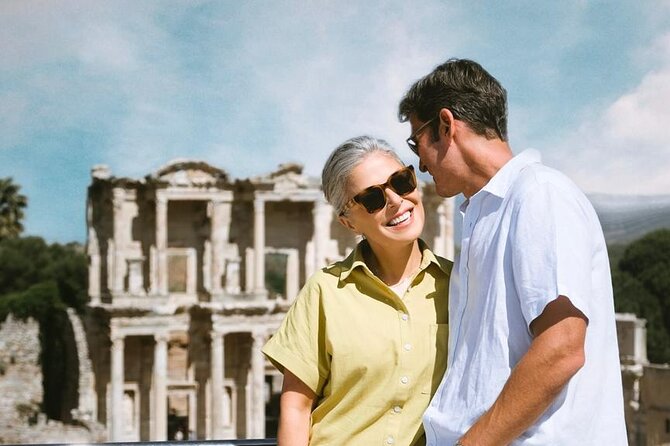
The ancient city visit lasts about two hours, though the full sequence includes several named stops within the site. You see Harbour Street, Marble Street, the Commercial Agora, the Latrina, Hadrian’s Temple, the Scholastica Baths, Trajan’s Fountain, Curetes Street, the Polio Fountain, Memmius Monument, the Temple of Domitian, the Prytaneion, Odeion, and State Agora.
That list may sound like a blur of ancient names. A good guide helps you connect them. The streets were not simply routes between monuments. They were the city’s public stage, lined with fountains, baths, religious buildings, shops, meeting places, and homes.
The State Agora is especially useful for understanding civic life. Built in the first century BC, it was used for government business rather than ordinary commerce. Excavations also found earlier graves, an archaic terracotta sarcophagus, a paved road, and a water reservoir.
That reservoir points to the engineering behind Ephesus. Water reached the city through the Pollio Aqueduct, whose remains can be seen about five kilometers away along the Selçuk-Aydin highway. Details like this help you see Ephesus as a working city, not a collection of isolated stones.
The Odeion looks like a small theatre, but it served two purposes. It was a meeting hall for the Boule, or city council, and a concert venue. It held about 1,500 people and was once covered by a wooden roof.
The distinction between the Odeion and the Great Theatre matters. The Great Theatre hosted public gatherings and major performances, while the Odeion was a more compact space for council business and concerts. You can see how Ephesus had different places for public debate, government, religion, and entertainment.
Domitian’s Temple and the politics of imperial honor
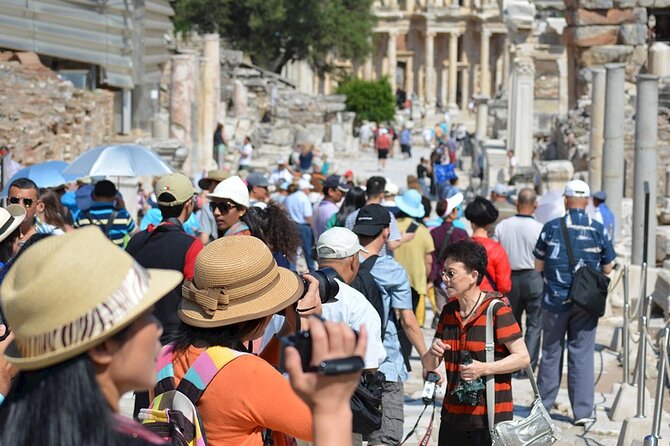
The Temple of Domitian sits at the southern end of Domitian Street. It was the first known Ephesus structure dedicated to an emperor, and its scale reflected the honor attached to imperial worship.
The temple stood on a terrace measuring about 50 by 100 meters, supported by vaulted foundations. Much of what you see today consists of foundations and surviving architectural elements, but the setting makes the building’s former size easier to understand.
The story here is political. Permission to build an emperor temple helped Ephesus gain the title of neokoros, a major honor for a Roman city. This is one of the stops where a guide’s explanation adds far more than a quick photograph.
More Private Shore Excursions in Turkey
- Private Tour in Ephesus and Traditional Turkish Bath from Port
★ 5.0 · 675 reviews - FOR CRUISE GUESTS:BEST SELLER EPHESUS PRIVATE TOUR/On Time Return
★ 5.0 · 614 reviews - Ephesus Small Group – Semi Private Shore Excursion
★ 5.0 · 406 reviews - ONLY FOR CRUISE GUESTS: Best Seller Highlights of Ephesus Private Tour
★ 5.0 · 297 reviews
Hercules Gate and the end of vehicle traffic
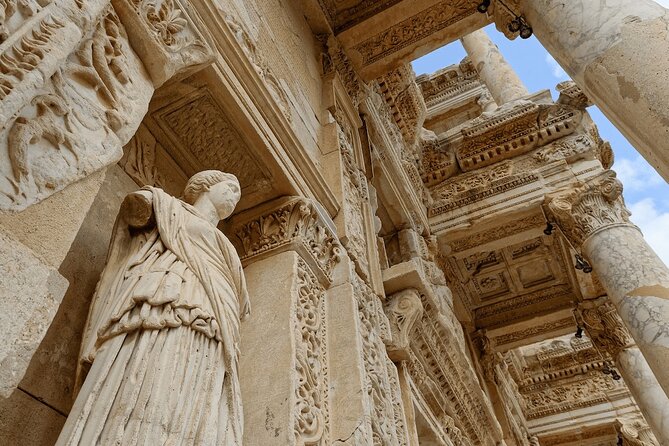
Hercules Gate is marked by two surviving column sides with reliefs of Hercules. The gate was moved to its current position in the fourth century AD, while the reliefs date to the second century.
Its practical role is more interesting than its decoration. The gate narrowed Curetes Street so vehicles could no longer pass. By the fourth century, this part of Ephesus had become a pedestrian area.
That small detail changes how you picture the street. The ancient city was not always filled with carts and traffic. Parts of it had already become walking-only zones, much like a modern historic center.
Hadrian’s Temple and the famous Curetes Street
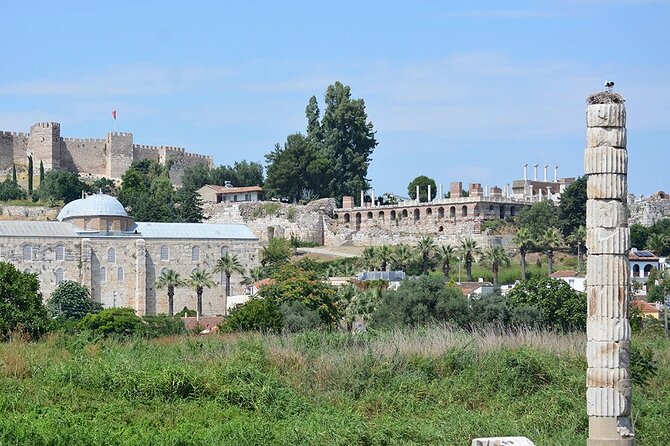
Hadrian’s Temple is one of the best-preserved structures on Curetes Street. Built before AD 138, it honored Emperor Hadrian after his visit to Ephesus in AD 128.
The front has four Corinthian columns beneath a curved arch, with a relief of Tyche, the goddess of victory. The pedestal in front once supported statues of four later emperors, though the statues themselves are missing.
This is a good place to slow down. The decoration is elegant, but the building also shows how public monuments were updated as emperors changed. Ephesus was constantly adapting its public image to the rulers of Rome.
The Terrace Houses are worth the extra ticket
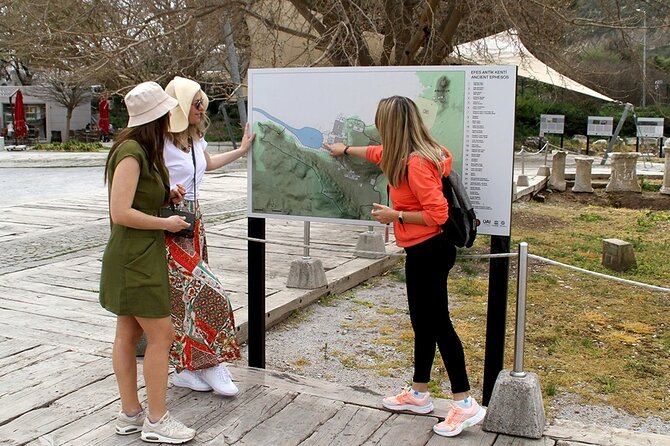
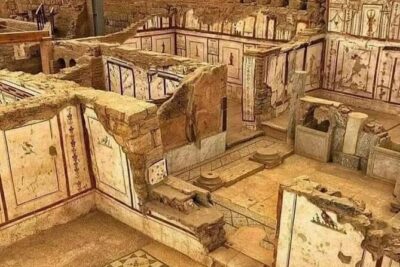
The Terrace Houses are the tour’s best choice for anyone who wants to see ordinary domestic life at a high social level. These were homes of wealthy Roman families, built on three terraces along the lower slope of Bulbul Mountain.
Six residential units have been identified. The oldest building dates to the first century BC, and the homes continued in use until the seventh century AD. Two houses are open as a museum under protective roofing.
Inside, you see preserved mosaics and frescoes, along with rooms arranged around the patterns of Roman domestic life. The site involves stairs, and one visitor specifically noted that there are many of them. Still, the extra €15 admission is worthwhile if you want more than temples and public monuments.
The Terrace Houses also give context to the grand streets below. Wealthy residents did not merely pass through Ephesus for public business. They lived there, decorated their homes, hosted people, and watched the city change over centuries.
The Library of Celsus and the Great Theatre
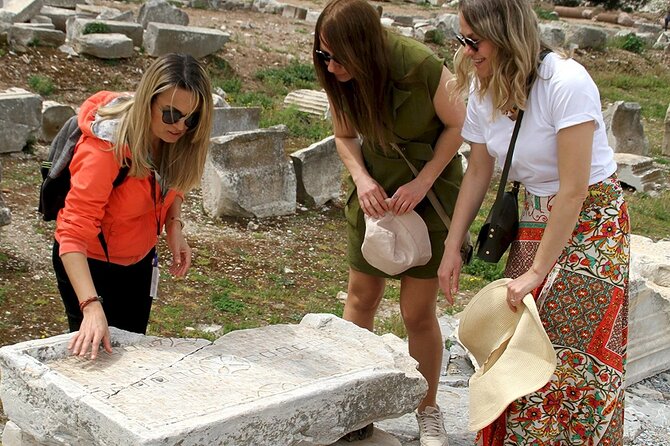
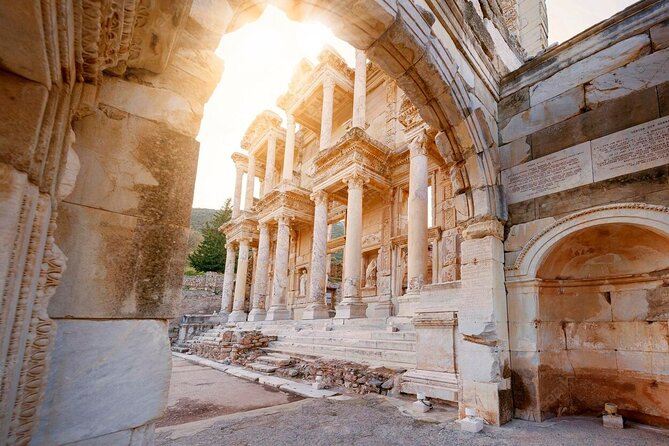
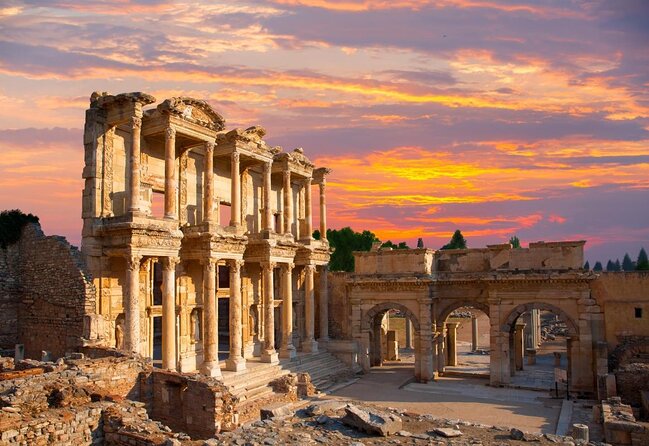
The Library of Celsus is the visual star of Ephesus. Built in AD 117, it was also a monumental tomb for Gaius Julius Celsus Polemaeanus, governor of the province of Asia. His burial chamber lies beneath the ground floor.
The library held more than 12,000 scrolls. Double walls behind the book niches helped protect the manuscripts from temperature and humidity changes. The building was both a memorial and a center of learning, which explains why it remains such a powerful symbol of the city.
You have about 30 minutes here. That is enough to hear the main story and study the facade, though you may wish for extra time if you like ancient architecture or photography.
The Great Theatre is larger and more dramatic. First built in the Hellenistic period in the third century BC, it was expanded under Roman rule. It held about 25,000 people and remains the largest ancient theatre in Anatolia.
The theatre was used for plays and concerts, but also for religious events, political meetings, philosophical discussions, gladiator contests, and animal fights. The public life of Ephesus gathered here in a way that the smaller Odeion could not match.
This is the only major ancient-site admission specifically listed as included in the itinerary. The general Ephesus entry fee is still listed separately at €40 per person, so confirm exactly what your booking covers before you arrive.
Artemis Temple and St. John’s Basilica
The Temple of Artemis is one of the Seven Wonders of the ancient world, but the present site can surprise you. Only the foundations and a small number of surviving pieces remain, and the ancient building stood in an area that later became marshy.
The stop lasts about 40 minutes, which gives your guide time to explain the temple’s former size and importance. You will not see a complete wonder. You will see the place where it stood and understand how little survives on site.
Many of the finest remaining architectural pieces are now in the British Museum in London. That can be frustrating, but it also helps explain why the local ruins look so sparse.
St. John’s Basilica offers a different kind of monument. Tradition holds that the Apostle John spent his final years around Ephesus and was buried on the southern slope of Ayosolug Hill. A small chapel was built over the grave in the fourth century, and Emperor Justinian later ordered a large basilica in the sixth century.
The basilica stop lasts about 40 minutes and costs €6 separately. It adds early Christian history to a day otherwise dominated by Greek and Roman remains.
Lunch, the Mercedes van, and possible shopping stops
Lunch is included, but drinks are not. The meal is described as plentiful Turkish food, and a local restaurant visit gives the day a needed pause after several hours among exposed stone and hills.
One particularly nice touch reported from the day is a guide offering local figs and fresh-squeezed pomegranate juice. Those extras are not guaranteed, so treat them as guide-dependent rather than part of the formal package.
Transport is by an air-conditioned Mercedes van. That matters in Kusadasi, where the day may include several drives and a lot of walking. Parking fees are covered, and hotel or port drop-off is included.
Some departures include a carpet-weaving demonstration after lunch. You can learn how rugs are made, but the visit may become a sales presentation. The staff are described as polite, yet several people felt some pressure to buy.
I would treat this as a possible trade-off. If you are interested in Turkish rugs, it can be useful. If you want every minute at the ruins, ask your guide early how much time the stop will take and whether it can be skipped.
What the $79.20 price really means
At $79.20 per person, the base price is attractive for a private tour with a licensed English-speaking guide, lunch, a private vehicle, parking, and pickup and drop-off.
The extra admission fees change the calculation. If you visit all the ticketed places listed, the stated charges total €79 per person:
- Ephesus Ancient City: €40
- House of Virgin Mary: €18
- Terrace Houses: €15
- St. John’s Basilica: €6
Drinks at lunch cost extra as well. The price can still represent good value for a private vehicle and guide, especially for a family or small group that would otherwise book several separate services. But do not compare $79.20 with an all-inclusive group excursion. It is the starting price before several important tickets.
Timing, fitness, and cruise-ship caution
The experience lasts about five to seven hours. You need a moderate fitness level because Ephesus involves uneven ancient paving, sloped streets, standing, and stairs at the Terrace Houses.
The cruise pickup system is clear: meet at the exit gate of the immigration terminal with the OTTI Travel sign. At the end of the day, the driver returns you to the port.
Still, I would give the guide a firm return time before setting out. One departure arrived late enough that the cruise line delayed sailing by 30 minutes. That was a fortunate outcome, not a planning strategy. Provide the ship name, docking time, disembarkation time, and re-boarding time when booking, then repeat the all-aboard time to your guide in person.
The tour is free to cancel up to 24 hours before the start time for a full refund. Changes made less than 24 hours before the start are not accepted.
Should you book this Ephesus tour?
Book it if you want a broad, private look at Ephesus rather than a quick visit to the Library of Celsus. The route covers civic buildings, Roman homes, Christian remains, the Artemis site, and the major theatre, while the private format lets your guide adjust the day.
It suits couples, families, and small groups who value personal explanations and comfortable transport. Ask for Selin, Nesli, Ahmet, Asli, Tas, Mary, or Özgür if available, since each has been singled out for friendly, flexible guiding.
Skip it if you want a bare-bones archaeological visit with no extra fees, or if you dislike the possibility of a carpet sales stop. Also think twice if your cruise schedule is very tight. With the ticket costs added, this is best viewed as a full private day of guiding, transport, lunch, and multiple sites, not a $79.20 all-in admission bargain.
FAQ
How long does the private Ephesus tour last?
The tour lasts approximately five to seven hours.
What language is the tour offered in?
The tour is offered in English with a professional licensed English-speaking guide.
Is pickup included?
Yes. Pickup and drop-off are included from the Kusadasi cruise port, hotels, and the domestic airport.
Where do cruise passengers meet the guide?
Cruise passengers meet at the exit gate of the immigration terminal at the cruise port. Look for a board with the OTTI Travel sign.
Is lunch included?
Yes. Lunch at a local restaurant is included. Drinks are not included.
Is the tour private?
Yes. Only your group participates in the private tour.
What entrance fees are extra?
The listed extra fees are €40 for Ephesus Ancient City, €18 for the House of Virgin Mary, €15 for the Terrace Houses, and €6 for St. John’s Basilica.
Is the Great Theatre admission included?
The itinerary lists admission to the Ephesus Ancient Greek Theatre as included, while the general Ephesus Ancient City admission is listed separately at €40 per person. Confirm the exact ticket arrangement when booking.
Is the Terrace Houses visit included?
The Terrace Houses are part of the itinerary, but admission is separate and listed at €15 per person.
Can I cancel for a refund?
You can cancel at least 24 hours before the local start time for a full refund. Cancellations or changes made less than 24 hours before the start are not accepted.
More Shore Excursions with Lunch in Turkey
- FOR CRUISERS: PRIVATE EPHESUS TOUR INCLUDES ENTRY FEES & Lunch
★ 5.0 · 40 reviews - Ephesus Tour For Cruisers from kusadasi with Lunch(skip the line)
★ 5.0 · 36 reviews - SKIP-THE-LINE: BEST OF EPHESUS PRIVATE TOUR with Lunch & ENTRY
★ 4.5 · 22 reviews - ALL INCLUSIVE: PRIVATE Ephesus, Mary’s House, Artemis with LUNCH
★ 5.0 · 22 reviews
More Shore Excursions with Lunch in Kusadasi
- Top Choice For Cruisers: Ephesus, Mary’s House WITH TICKETS+LUNCH
★ 5.0 · 7,233 reviews - ALL INCLUSIVE VIP Shore Excursion Customizable Ephesus with Lunch
★ 5.0 · 361 reviews - ALL INCLUSIVE Private Ephesus, Terrace Houses tour with LUNCH
★ 5.0 · 203 reviews - Kusadasi Shore Excursion: Ephesus Sightseeing Tour with Lunch
★ 4.5 · 145 reviews
Just added around Kusadasi
- Ephesus Shore Excursions For Cruisers★ 5.0 · 3 reviews
- Skip Lines: Ephesus PRIVATE TOUR For Cruise Guests★ 5.0 · 11 reviews
- Private Guided Ephesus Tour for Cruise Travelers★ 5.0 · 2 reviews
- Skip the Line: Ephesus TOUR For Cruise Guests – Small Group★ 5.0 · 3 reviews
- Small Group Ephesus Shore Excursion from Kusadasi Port★ 5.0 · 4 reviews
- The Best of Ephesus Tour For Cruisers★ 4.0 · 3 reviews
- FOR CRUISERS: Best of Ephesus Tour with GUARANTEED ON-TIME RETURN★ 5.0 · 3 reviews
- FOR CRUISERS: Best Seller of Ephesus Private Tour by Locals★ 5.0 · 5 reviews
Kusadasi Shore Excursions, compared.
Skip The Lines PRIVATE EPHESUS TOUR &On Time Return
Read our review →
PRIVATE EPHESUS TOUR FOR CRUISERS: On-time Return and Skip-Line
Read our review →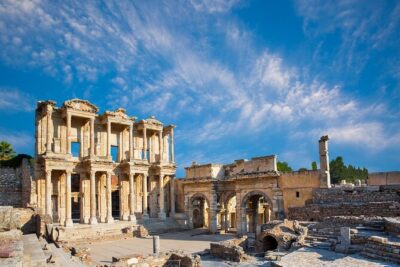
PRIVATE TOUR FOR CRUISERS: Mary’s House (Meryemana) and Ephesus
Read our review →
Ephesus & Artemis Tour for Cruisers WITH ENTRY TICKETS
Read our review →
Ephesus: Small Group Tour for Cruise Passengers
Read our review →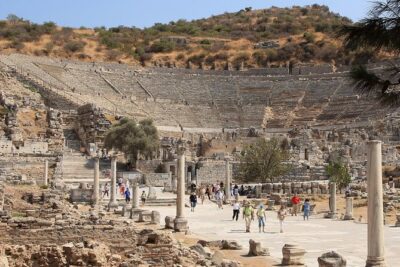
Top-Rated Ephesus and House of Virgin Mary Tour for Cruisers
Read our review →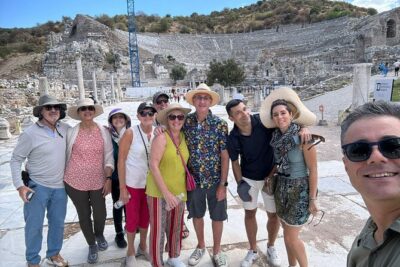
Ephesus Small Group – Semi Private Shore Excursion
Read our review →