REVIEW · TOURS
Shared Montevideo Tour for Cruisers
Montevideo reveals itself in pieces on this three-hour city tour: colonial squares, marble government buildings, a famous soccer stadium, a coastal promenade, and the broad waters of the Río de la Plata. You ride between sights in an air-conditioned vehicle, so you can cover far more ground than you could on foot from the cruise port.
I like two things right away. First, the route gives you a useful first look at several very different parts of the city, from the old center to Pocitos Beach and Parque Batlle. Second, $27 is a strong price for a port-day overview, especially when compared with the higher cost of many cruise-line excursions. The possible catch is the pace: stops are short, and guide quality, English clarity, vehicle size, and WiFi service can vary.
Key points to know before booking
- A wide city snapshot: See the Old Town, Parliament, Independence Square, Mercado Agricola, Pocitos, the Centenario Stadium, and Mercado del Puerto.
- Good port-day value: The tour costs $27 per person and returns to the cruise terminal.
- Short photo stops: Most stops last from 5 to 15 minutes, with about 30 minutes at Mercado Agricola.
- Guide quality matters: Rodrigo and Rosario received especially strong praise, while some passengers found other guides hard to understand.
- Vehicle size may vary: The advertised maximum is 38 people, but some departures use a smaller minibus.
- Plan for a quick look, not a deep visit: This is a city sampler, not a museum or food tour.
Why this route works for a short Montevideo port call
Montevideo is spread out, and that matters when your ship is in port for only part of a day. The historic center lies near the harbor, but Pocitos Beach, Parque Batlle, and the Centenario Stadium are farther away. This bus route lets you connect those areas without spending your limited time figuring out local transport.
I like the balance of the route. You get grand civic buildings, everyday markets, public art, beach scenery, and soccer culture. That mix gives you a better sense of Montevideo than a tour focused only on old buildings.
The format is simple: ride between stops while the guide explains the city, then get out at selected points for a look around or a photograph. Several passengers found the guides warm, funny, and well informed. Rodrigo is singled out repeatedly for his clear English, patience, and ability to answer questions. Rosario also receives high marks for careful organization and attention to detail.
Still, you should set your expectations correctly. The stated duration is about three hours, and some individual stops last only five or ten minutes. You will see a lot, but you will not have time to tour the Parliament interior, browse every museum, linger over lunch, or shop at length.
A few more shore excursions around the world worth a look
- FOR CRUISERS: Skip The Lines PRIVATE EPHESUS TOUR &On Time Return
★ 5.0 · 8,527 reviews - Top Choice For Cruisers: Ephesus, Mary’s House WITH TICKETS+LUNCH
★ 5.0 · 7,233 reviews - PRIVATE EPHESUS TOUR FOR CRUISERS: On-time Return and Skip-Line
★ 5.0 · 5,807 reviews
Starting at the cruise terminal
The meeting point is at the Point Terminal de Cruceros Montevideo, near the internet café and souvenir shop inside the port terminal. The listed start window is 9:00 to 9:30 a.m., Monday through Sunday, for the operating period shown through May 2027. The activity returns to the same meeting point.
That return is important. You are not left in the city to arrange your own way back to the ship. One passenger also reported being dropped off earlier by request, allowing extra time near the port, but do not assume that option is always available. Ask the guide on the day.
Port timing deserves care. One departure had already left when a passenger arrived at 9:30, while another group waited for people who did not appear. Your confirmation should be checked closely, especially if your ship docks earlier or later than planned. Since this is a cruise excursion, allow enough time to get off the ship and walk to the terminal meeting point.
The vehicle is air-conditioned, and WiFi is advertised. In practice, WiFi has been uneven. It worked well for some groups, but other passengers spent too much time trying to connect or could not use it at all. Treat WiFi as a bonus, not a reason to book.
Plaza Matriz and Montevideo’s old center
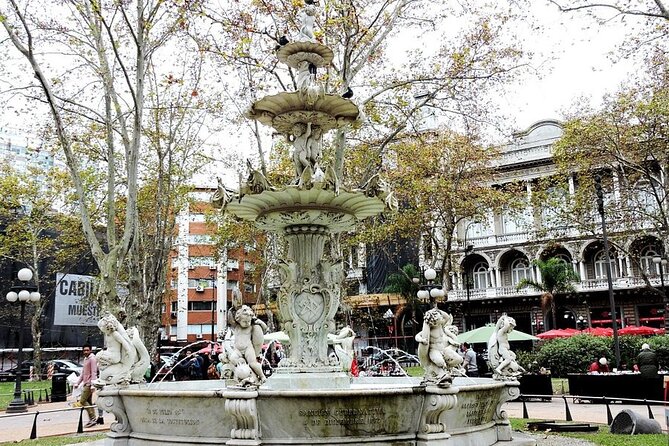
The first substantial stop is Plaza Matriz in the Old Town. This is where the city’s colonial and civic story comes into view. You can see the Metropolitan Cathedral, the Cabildo, the Solís Theatre, and buildings connected with the old Spanish fortifications.
The original fortified city was bounded by stone walls and protected by the Ciudadela. Today, the area feels less like a fortress and more like a walkable historic district, with cafés, galleries, museums, antique shops, and handsome older buildings.
The scheduled stop is only about ten minutes. That is enough for orientation and photographs, but not enough for a proper museum visit. If your main goal is the Solís Theatre, Museo Torres García, or the Cabildo, you will need a longer independent visit on another day.
A guide adds real value here because the buildings are close together but easy to blur into one sequence of façades. Listen for the explanation of how the old walls shaped the city. At the same time, stay near the group. One guide was criticized for walking too fast, making it difficult for older passengers to keep up.
Parliament Palace and the Mercado Agricola
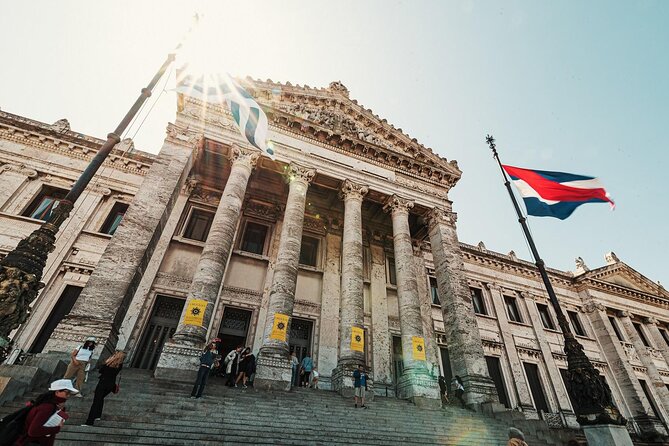
The Palacio Legislativo is the seat of Uruguay’s legislative power. Its marble, formal design and carefully planned grounds make it one of Montevideo’s major civic sights. The scheduled stop is only five minutes, so expect an exterior view rather than a tour inside.
That short stop can feel rushed if you want architecture photographs. Still, seeing the Parliament building helps explain the importance Uruguay places on its democratic institutions. The tour also passes the building again in the broader city route, giving you another chance to view it from the vehicle.
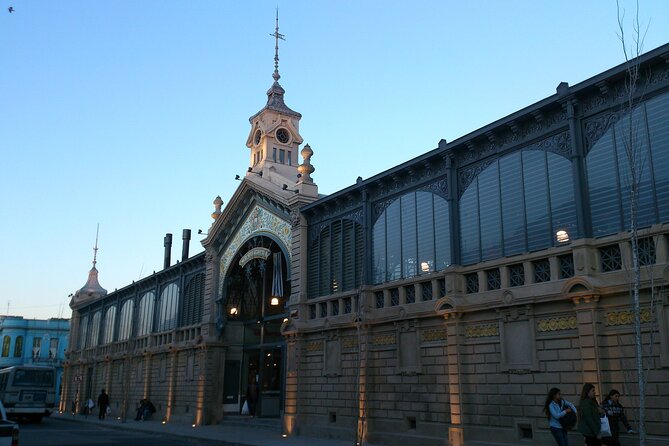
From the Parliament area, the bus continues to Mercado Agricola Montevideo, usually called MAM. This is one of the more useful stops because you get about 30 minutes, much longer than at the civic buildings.
The market began as a fruit and vegetable stand in 1913 and grew into a city-block-sized shopping center. Its iron structure is one of the last of its type in Montevideo. After restoration in 2006, the building helped renew the surrounding neighborhood.
Inside, you can still find fresh fruit and vegetables, along with other goods and small shops. It is a better place to see ordinary city life than a purely monumental sightseeing stop. You might have time for a quick look, a snack, or a restroom break, but do not expect a long shopping session. One passenger specifically wished the guide had pointed out that toilets were available there.
Same port, a different day ashore:
- From the Port of Kos: Full Day Boat Cruise to 3 Islands
★ 4.8 · 5,137 reviews - Hilo Shore Excursion: Volcanoes National Park & Black Sand Beach
★ 4.5 · 2,338 reviews - Daintree Rainforest, Mossman Gorge Small-Group from Port Douglas
★ 5.0 · 2,326 reviews - Arrecife: Timanfaya and Green Lagoon for Cruise Passengers
★ 4.6 · 2,010 reviews
Independence Square and the city’s central symbols
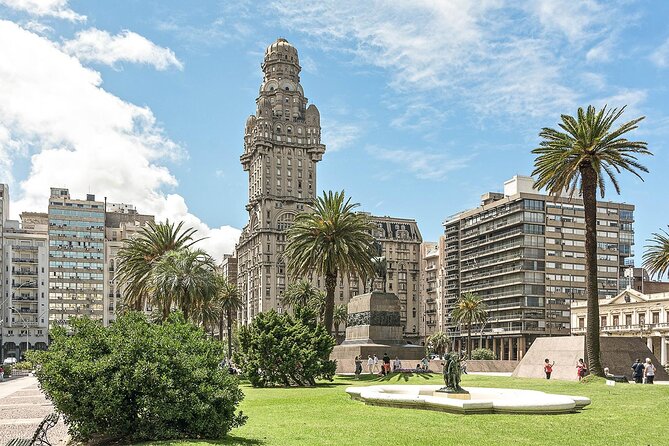
Plaza Independencia brings together several of Montevideo’s most recognizable sights. You will see the statue and mausoleum of General Artigas, Uruguay’s national hero, along with the Presidential offices, Palacio Estévez, Palacio Salvo, and the Ciudadela Gate.
The square is a useful bridge between the old fortified city and the newer central area. Palacio Salvo, with its distinctive profile, is one of the city’s best-known buildings. The Artigas mausoleum below the square gives the site a more solemn character.
The scheduled stop is about ten minutes. You will have time to understand the layout and take photographs, but not to explore each building. The guide’s explanation is particularly useful here because the square combines political, military, and national history in one compact place.
The tour also refers to the Parliament Palace in connection with Uruguay’s democratic values and neoclassical architecture. If you enjoy civic architecture, this section of the route will be one of the strongest parts. If you prefer cafés, local shops, or time on foot, the short schedule may feel too tight.
Parque Batlle, La Carreta, and Uruguay’s soccer story
The Monumento a la Carreta sits in Batlle Park. José Belloni created the bronze work, inaugurated in 1934, showing oxen pulling a covered wagon. It recalls gaucho life, rural work, and the days before cars and railways changed transport.
The stop lasts about ten minutes. The monument is large and easy to photograph, and the guide can connect it with Uruguay’s rural past. It is a welcome change from the formal government buildings in the city center.
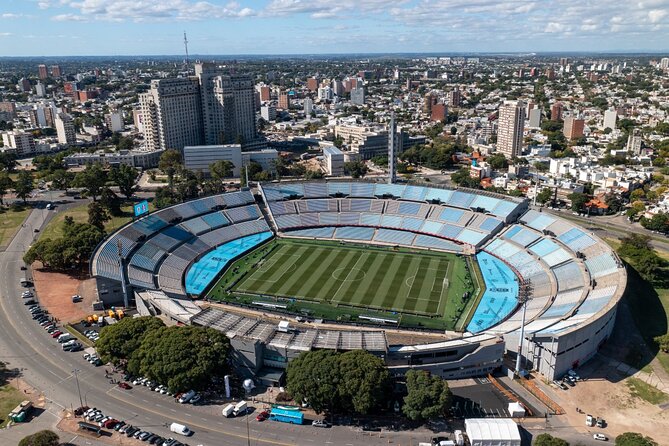
Nearby is Estadio Centenario, opened in 1930 for the first World Cup, which Uruguay won. FIFA declared it a World Football Historical Monument in 1983. You will have roughly 15 minutes in this area, with time to see the stadium and the surrounding public park.
This is a particularly good stop if you follow soccer. The stadium is not just a sports venue; it is tied to one of the defining events in Uruguay’s national identity. If soccer does not interest you, the stop is still worthwhile for the park and the scale of the stadium, but it may not be the highlight of your morning.
Pocitos Beach and the Montevideo sign

The tour then heads toward Pocitos Beach, one of the city’s best-known coastal areas. You can pose beside the large Montevideo letters and look across Pocitos Bay.
This is one of the clearest photo stops on the route. The letters give you an easy souvenir photograph, while the beach offers a quick change of mood after the old center and civic buildings. The stop lasts about 15 minutes, enough for pictures and a short look at the shoreline.
The larger coastal setting is the Rambla de Montevideo, a 24-kilometer avenue and pedestrian promenade along the Río de la Plata. It links beaches and neighborhoods including Ramírez, Pocitos, Buceo, Malvín, and Carrasco. The bus route only gives you a taste of this long waterfront, but the ride helps you see how central the coast is to daily life in Montevideo.
On weekends, the Rambla attracts people walking, cycling, fishing, and enjoying the open air. It also offers bird-watching opportunities and yacht areas around Punta Carretas and Buceo. You will not explore all of that on this tour, but the coastal drive is one reason the bus format works well.
Mercado del Puerto and the ride back
Mercado del Puerto is the final listed stop, with about eight minutes for a brief look. The iron market structure was built in Liverpool, and today the area is known for restaurants and large grills cooking Uruguayan beef.
Eight minutes is not enough for a proper meal. If you want to eat at the market, plan to return independently only if your ship schedule and tour arrangements allow it. The surrounding streets may also feature artists and performers, adding a more informal feel than the grand plazas.
The ride back follows the Río de la Plata and brings you toward the port. That final stretch gives you more coastal views and a chance to absorb the city after the rapid succession of stops.
Some passengers feel the tour spends too much time on the bus, while others appreciate the chance to cover distant parts of Montevideo without walking in the heat. Both reactions make sense. Your experience will depend on traffic, group size, the guide’s delivery, and how much you value seeing many places quickly.
Group size, guides, and communication
The advertised maximum is 38 people. Actual departures can be smaller, including minibus groups of around ten to fifteen people. A smaller vehicle makes getting on and off easier and usually helps the guide answer questions.
Larger groups can still work, but boarding takes longer and the short stops feel even shorter. One passenger booked a small-party experience but ended up on a bus of about 50, so it is sensible to confirm the vehicle and group size if that matters to you.
Guide quality is the most important variable. Rodrigo receives especially strong praise for his English, humor, patience, and command of Uruguayan history. Rosario is also noted for being helpful, organized, and attentive. Other departures had problems with fast speech, strong accents, or bilingual narration that made the English difficult to hear.
If the tour is given in both English and Spanish, expect the commentary to take longer. Sit near the front if possible and tell the guide if you cannot hear. A good microphone system has helped some groups, but it cannot solve every issue from the back of a full coach.
Is $27 good value?
At $27 per person, this is inexpensive for a guided city tour with transport. You are paying mainly for the route, the guide, and the convenience of returning to the port. There are no listed admission fees, and the stops are mostly exterior or public spaces.
The value is strongest if you have never seen Montevideo and want a quick orientation. You cover far more ground than a self-guided walk from the harbor, including neighborhoods that are too far away for a short stroll.
The value is weaker if you want long visits, serious shopping, a sit-down meal, or access inside major buildings. You could spend your morning walking the Old Town and nearby port market, but you would miss Pocitos, the Rambla ride, Parque Batlle, and the Centenario Stadium.
Free cancellation is available up to 24 hours before the start time. Changes or cancellations inside that period are not accepted for a refund.
Who should book this Montevideo tour?
I would choose this tour if you have one port day, want a broad first look, and prefer sitting in an air-conditioned vehicle between stops. It suits couples, families, and solo visitors who want a guide to explain what they are seeing rather than simply walk from one building to the next.
It is also a good fit for anyone interested in Uruguay’s political buildings, soccer heritage, public markets, and coastal life. The mix is broad enough to keep the morning varied.
I would hesitate if you have limited mobility and need a slow pace, since one guide was reported to walk too quickly and the schedule is tight. I would also hesitate if WiFi is important, if you need guaranteed English clarity, or if your ideal excursion means spending an hour or more in one place.
FAQ
How long is the Montevideo tour?
The tour lasts approximately three hours.
Where does the tour begin?
It begins at the Point Terminal de Cruceros Montevideo, near the internet café and souvenir shop at the cruise terminal.
Where does the tour end?
The activity ends back at the cruise terminal meeting point.
What sights are included?
The route includes Plaza Matriz, Palacio Legislativo, Mercado Agricola Montevideo, Plaza Independencia, the Carreta Monument, the Montevideo letters at Pocitos Beach, Estadio Centenario, Mercado del Puerto, and views along the Rambla.
Is transportation provided?
Yes. You travel between stops in an air-conditioned vehicle.
Is WiFi available?
WiFi is advertised on board, but service has not worked consistently on every departure.
How many people can join the tour?
The maximum stated group size is 38 travelers, though some departures use smaller minibuses.
Can I cancel for a refund?
Yes. You can cancel at least 24 hours before the experience start time for a full refund. Cancellations or changes made less than 24 hours before the start time are not accepted.
Should you book it?
Book this tour for breadth, convenience, and price. It gives you a useful look at Montevideo’s old center, civic architecture, soccer culture, markets, and coast without risking a long independent journey away from the ship.
Just treat it as an introduction. The stops are brief, the bus and guide may vary, and WiFi is not guaranteed. If you get a strong English-speaking guide such as Rodrigo or Rosario, the morning can be an excellent value. If you want a slower, deeper visit, spend your time in the Old Town and port area instead.
Just added around the world
- Private Shore Excursion Livorno Port “Discovery Pisa & Florence”★ 5.0 · 16 reviews
- Florence and Pisa Exploration from Livorno Cruise Port★ 4.0 · 3 reviews
- Deluxe Florence and Pisa Tour from Livorno Cruise Port★ 4.5 · 32 reviews
- Florence and Lucca Shore Excursion from Livorno Port★ 5.0 · 2 reviews
- Private VIP Exclusive Tour of Cinque Terre – Shore Excursion from Livorno/Spezia★ 3.5 · 2 reviews
- Florence Hop On Hop Off Shore Excursion from Livorno★ 4.0 · 28 reviews
- Cinque Terre Shore Excursions from Livorno Port★ 4.5 · 33 reviews
- Day Tour in Livorno and Pisa Shore Excursion from Livorno★ 4.0 · 3 reviews
Tours, compared.
Skip The Lines PRIVATE EPHESUS TOUR &On Time Return
Read our review →
PRIVATE EPHESUS TOUR FOR CRUISERS: On-time Return and Skip-Line
Read our review →
PRIVATE TOUR FOR CRUISERS: Mary’s House (Meryemana) and Ephesus
Read our review →
Ephesus & Artemis Tour for Cruisers WITH ENTRY TICKETS
Read our review →

Ephesus: Small Group Tour for Cruise Passengers
Read our review →