
REVIEW · CRUISE PORT TRANSFERS
Split and Trogir Half Day Tour from Split (with port pickup)
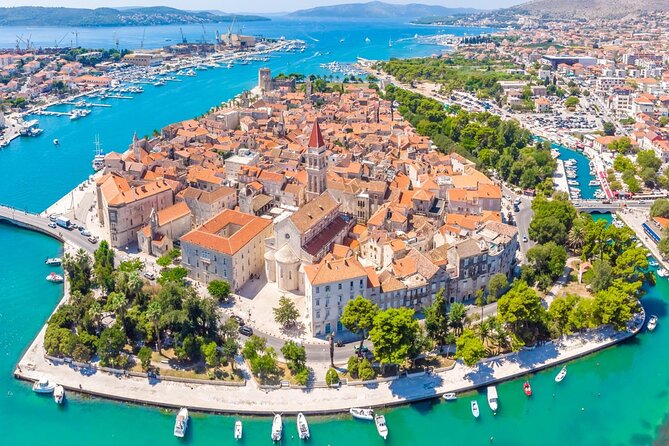
The most useful thing about this tour is that it joins Trogir and Split in one compact morning. You get a coastal ride, a guided walk through Trogir’s old center, and time around Diocletian’s Palace without having to arrange separate transport. Guides including Tina, Sandra, Roko, and Hrvoje are praised for clear storytelling, humor, and care with the group.
I like the simple port pickup and the chance to compare two very different historic towns in one outing. I also like the free time built into the day, which lets you browse, eat, or try the gelato in Trogir instead of being marched from one monument to the next. The main caution is pace: four hours is short, there can be a fair amount of walking, and traffic or rain may cut into sightseeing.
Key points to know before booking
- Trogir comes alive in the old center: Romanesque churches, Venetian buildings, narrow lanes, and the waterfront fit into a very walkable historic core.
- Diocletian’s Palace is not a single isolated ruin: It forms much of Split’s old center, so the tour places ancient Roman remains right inside a living city.
- Port pickup is well planned, but read the instructions closely: Look for the Croatian Trails sign near the red hop-on, hop-off buses at the terminal entrance.
- The tour can feel personal or fairly large: Some departures have had only seven people, while the maximum is 50.
- Entry fees are extra: The price covers guiding and transport, not admission tickets to paid sights.
- The return is to Split’s Riva, not the ship: Allow about 20 minutes to walk back to the cruise terminal, or ask the guide to help arrange a taxi.
Why this half-day pairing works
Split and Trogir are close enough to visit together, yet they offer different impressions of the Dalmatian coast. Trogir is compact and medieval, shaped by Greek, Roman, Venetian, and later Dalmatian traditions. Split feels larger and more layered, with the remains of a Roman emperor’s retirement palace folded into the modern city.
That contrast gives the tour its value. You are not spending four hours looking at variations of the same church facade. You move from Trogir’s stone lanes and fortress waterfront to Split’s busy central promenade and Roman palace rooms.
The price is about $78.61 per person. For a cruise stop, that is a reasonable fee if you want transport, a professional guide, and an organized route through both places. It is less attractive if you prefer to wander alone, dislike fixed timing, or plan to spend most of the day in just one town.
The tour is offered in English and lasts about four hours. It includes an air-conditioned vehicle, live commentary, taxes, handling charges, and port pickup. Food, drinks, admission fees, and return transport to the ship are not included.
More Cruise Port Transfers in Croatia:
- Mykonos Shore Excursion with Pickup from Cruise Ship Terminal
★ 4.5 · 766 reviews - Civitavecchia Private Transfer: Rome to Civitavecchia Cruise Port
★ 5.0 · 669 reviews - Mykonos Small Group Tour for Cruise Passengers — Port Pickup
★ 5.0 · 597 reviews
Starting at the Split cruise terminal
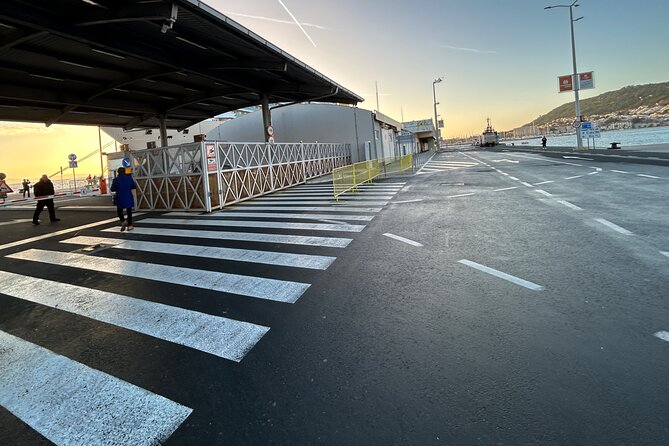
Cruise passengers meet at the New Split Berth for Cruise Ships on Obala kneza Domagoja 16. The pickup instructions matter here. The guide carries a Croatian Trails sign and waits at the entrance to the ship’s terminal, next to the red hop-on, hop-off buses, past the fence as you leave the ship.
Do not assume the guide will be standing directly beside the gangway. The meeting instructions point you toward the terminal entrance and the red buses. If your ship arrives early, the stated pickup is 9:00 a.m. for ships docking between 7:00 and 8:30 a.m. For later arrivals, the exact time is sent through Viator messages one week before the tour.
Cruise passengers must provide the ship name, docking time, disembarkation time, and required re-boarding time when booking. This is important because the operator adjusts pickup around the ship schedule. One reported mix-up came from a group booking with a later disembarkation time, so check the final message rather than relying only on the general 9:00 a.m. description.
If your ship is late or you miss the tour because of a late arrival, no refund is provided. Give yourself enough time to get off the ship, clear the terminal, and find the sign.
Trogir, where 2,300 years fit into a small center
The usual route begins with a short coastal drive to Trogir. The ride gives you a quick look at the coast and nearby countryside before the walking portion begins.
Trogir was founded by Greek colonists in the third century BC and has more than 2,300 years of continuous urban life. The old town is compact, which makes it a good place for a guided introduction. You can cover a great deal on foot without long transfers between sights.
The architecture is the main attraction. Romanesque churches sit near Renaissance and Baroque buildings from the Venetian period. This layering is easier to understand with a guide, since the town does not present its history in one neat museum display. A good explanation helps you see why a church portal, a stone courtyard, or a palace facade looks the way it does.
You should have about an hour in Trogir as part of the scheduled visit. Some departures include time to explore independently between guided sections. Use it for a coffee, local shopping, photographs, or a quick snack. Several guides have offered restaurant and shop suggestions, and one especially useful tip is to try the gelato in Trogir.
The limitation is that one hour passes quickly. If you want to enter several churches, climb a tower, shop at length, and eat a full meal, this tour will feel rushed. It works best when you accept that Trogir is an introduction, not a full-day study.
Kula Kamerlengo and Trogir’s waterfront defenses
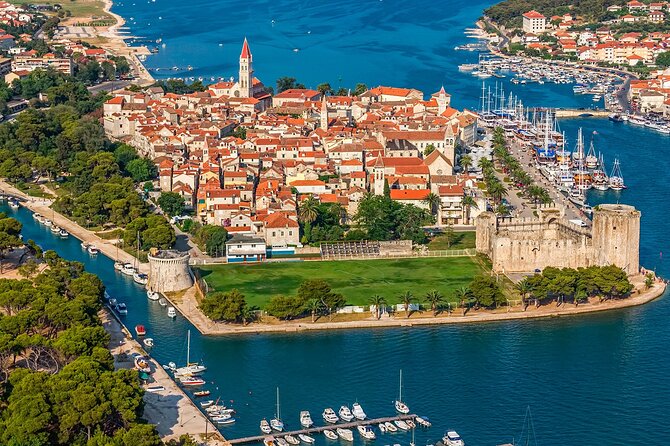
Kula Kamerlengo is a 15th-century fortress connected with Trogir’s defensive expansion. It grew from the earlier Veriga Tower and takes its name from the Italian term camerlengo, an administrative chamberlain.
The fortress helps explain Trogir’s position and its need for walls and towers. It is also used for summer performances, which gives the structure a life beyond its medieval function. You may have time to view it from outside and hear its story during the walking tour.
Admission is not included in the tour price. The schedule allows about 20 minutes for this stop, so do not count on a long interior visit unless your guide confirms that timing and access permit it.
A few more shore excursions around Croatia worth a look
- Split and Trogir Half Day Tour from Cruise Ships
★ 4.8 · 599 reviews - Split and Trogir private tour *ideal for cruise ship guests*
★ 5.0 · 210 reviews - Dubrovnik Shore Excursion: Explore Dubrovnik by Cable Car (ticket included)
★ 4.5 · 109 reviews - Private Krka Waterfalls with Wine and Prosciutto Shore Excursion
★ 5.0 · 98 reviews
Saint Lawrence Cathedral, Trogir’s architectural timeline

The Cathedral of Saint Lawrence is Trogir’s most imposing monument. It is a triple-naved basilica built over several centuries, using Romanesque and Gothic forms.
That long construction period is exactly what makes the cathedral useful for understanding Dalmatian architecture. Instead of showing one clean style, it shows how styles changed over time. You can see the result in the building’s mix of forms and details.
The scheduled visit is about 15 minutes, with admission listed as free for this stop. That is enough for an exterior explanation and a quick look, but not enough for a slow inspection of every carving and chapel. If church interiors matter greatly to you, ask the guide what is open during your visit.
Returning to Split and entering Diocletian’s world
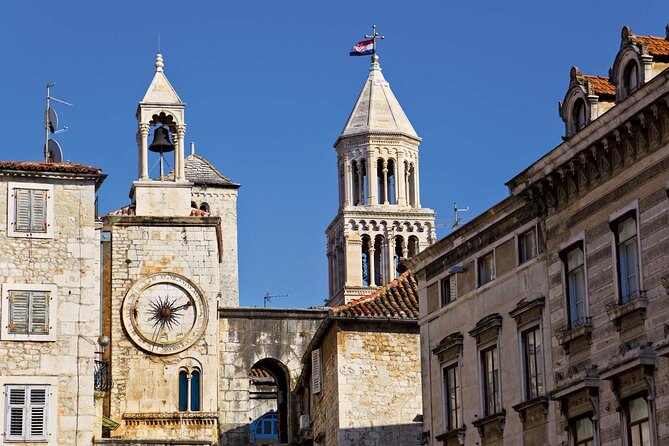
After Trogir, the coach returns toward Split. The ride is air-conditioned, a welcome feature in hot weather and a practical shelter if rain arrives. Traffic affects the exact transfer time, so the four-hour total is approximate rather than a guarantee.
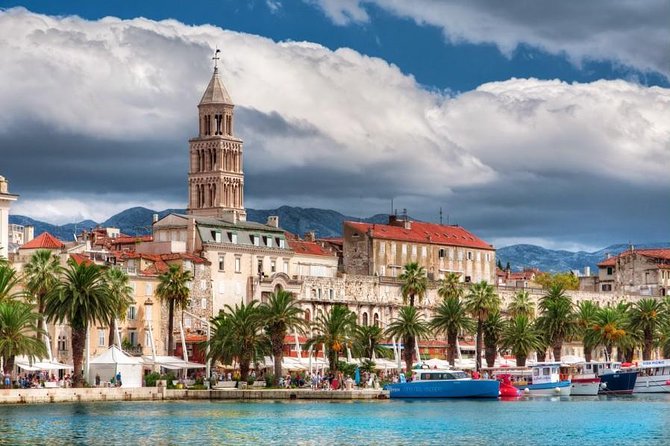
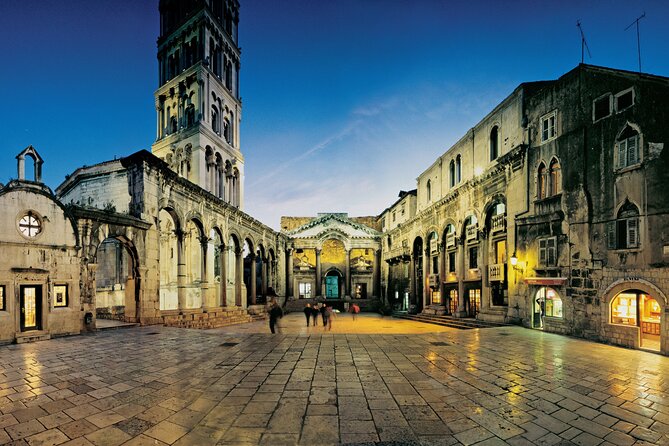
Split’s center is built around the Palace of Diocletian, constructed by the Roman emperor around the turn of the fourth century AD. Calling it a palace can mislead you. This was a large imperial complex, and today its remains make up roughly half of Split’s old town and city center.
The best part is the way ancient stone is mixed with ordinary city life. You are not looking at a remote ruin behind a fence. Streets, shops, restaurants, homes, and public spaces occupy and surround the old Roman structure.
The guided palace visit lasts about 20 minutes in the schedule. That is enough to establish the main story and point out key remains, but it is a brisk introduction. The palace is worth more time if you want to linger, take photographs, or explore smaller passages after the guided portion.
Admission is not included, so check which areas require a ticket on the day. The tour price covers the guide and transport, not paid entry.
Saint Domnius Cathedral and Split’s Roman core
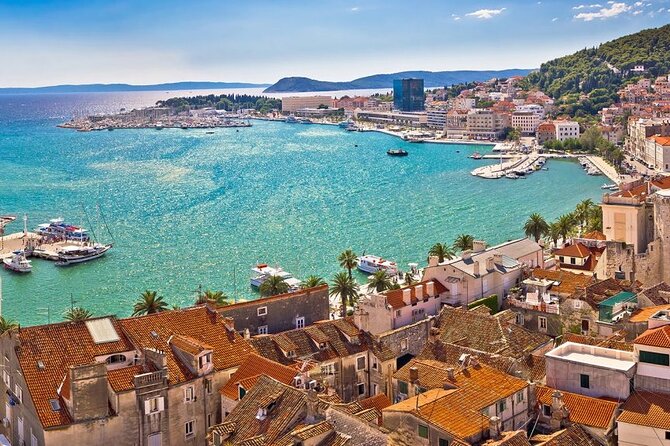
The Cathedral of Saint Domnius is an unusual building because the church was formed from a Roman imperial mausoleum. Strictly speaking, the church is dedicated to the Virgin Mary, while the bell tower is dedicated to Saint Domnius. Together they are known as the Cathedral of Saint Domnius.
This is one of the clearest examples of Split’s layered past. Roman imperial architecture, Christian worship, and the later city all occupy the same central space.
The scheduled stop lasts about 20 minutes, and admission is not included. If you want to climb the bell tower or spend longer inside, you will need to manage your time and budget separately. The short visit is best understood as a guided orientation, not an exhaustive cathedral tour.
Prokurative, Split’s Venetian-style square
Prokurative is a 19th-century square created under the supervision of General Marmont and promoted by Split mayor Antonio Bajamonti. Its design was inspired by Italian architecture and resembles St. Mark’s Square in Venice.
The connection is especially personal: the Venetian architect wanted the square to remind him of home. That small detail gives the place more character than simply calling it an Italianate plaza.
You have about 15 minutes here, and there is no admission charge. It is a quick but worthwhile stop, especially if you are interested in how Split continued to change long after the Roman period. The square also helps connect the old palace area with the more recent civic face of the city.
The guide can make or break a short tour
Four hours leaves little room for a flat presentation. The strongest guide reports center on Tina and Sandra, with repeated praise for their energy, clarity, humor, and care in hot weather. Tina is also described as a local schoolteacher with excellent English, and she is noted for using personal stories alongside the historical facts.
Roko, Hrvoje, Josipa, and other guides have also led departures. The exact guide is not guaranteed, but the strongest experiences share the same traits: clear organization, useful answers, and an ability to adjust when weather or group needs change.
This matters because the tour covers several centuries in a short time. A guide who simply recites dates will leave you with a blur of Roman, Gothic, Venetian, and modern references. A guide who explains how the buildings relate to one another can make the route easy to follow.
There is also a practical benefit. Guides have helped with food suggestions, shopping ideas, taxis, and the return walk to the ship. Several departures included local liquor and cheese sampling, but that should not be treated as a guaranteed part of every tour.
Walking, weather, and group size
You need moderate physical fitness. The route includes city walking, uneven historic surfaces, and time on your feet. One assessment placed it around Level 2, which is a useful warning for anyone managing mobility concerns.
Wear shoes with a firm sole and dress for the forecast. The tour operates in all weather, and one departure continued through heavy rain. Another took place in intense heat, with the guide checking on the group. Still, you are responsible for sun protection, water, and suitable clothing.
The maximum group size is 50. That is not a small-group promise. Some departures have been much smaller, including one with seven people, while others may be closer to the stated limit. A smaller group makes questions and street movement easier. A full coach can make the walking portions slower and less personal.
The operator uses an air-conditioned coach, which helps with the transfer between Split and Trogir. It does not change the fact that the old centers are explored on foot.
Ending at the Riva, not at the ship
The tour ends at Split Riva, the central waterfront promenade. This is a useful finish if you want lunch, shopping, or extra time in the old center.
It is not a cruise-terminal drop-off. The ship’s terminal is about a 20-minute walk away, and the guide can help you find a taxi if needed. Build this walk into your return plan, especially if you need to pass through security or reboard at a fixed time.
For a cruise stop, the ending location has two sides. You gain time in central Split rather than being driven straight back to the ship, but you must handle the final transfer yourself. The arrangement suits people who want to continue exploring. It requires more attention from anyone working with a tight ship schedule.
Who should book this tour?
I would choose this tour if you have one day in port and want a guided introduction to both Trogir and Split. It is especially useful if you value historical context, prefer not to organize local transport, and want a guide who can connect Roman, medieval, Venetian, and modern Croatia.
It also suits first-time visitors who want a reliable starting point before exploring independently. The free time in Trogir and the central finish in Split give you at least a little room to make your own choices.
I would think twice if you want a slow visit to one place, dislike group tours, need guaranteed small-group treatment, or want all admission fees included. The fixed schedule is efficient, but it leaves limited time for cathedral interiors, fortress visits, long meals, and unplanned wandering.
Free cancellation is available up to 24 hours before the start time for a full refund. Changes made inside that period are not accepted, and the minimum number of participants must be met for the tour to operate.
The final call
Book this half-day tour if you want maximum historical coverage with minimum planning. Trogir supplies the compact medieval setting, while Split gives you the remarkable experience of walking through a Roman palace that still functions as a city center.
The best practical plan is to confirm your pickup message, arrive at the correct terminal meeting point, wear good walking shoes, and leave enough time for the walk from the Riva back to your ship. At $78.61, the tour offers fair value for cruise passengers who want transport and a strong English-speaking guide. It is less compelling for independent explorers who can reach both towns easily and prefer to set their own pace.
FAQ
How long does the Split and Trogir tour last?
The experience lasts approximately four hours. Transfer times can vary with traffic and the time of day.
Where does port pickup take place?
Pickup is at the New Split Berth for Cruise Ships, Obala kneza Domagoja 16. Look for the Croatian Trails sign near the red hop-on, hop-off buses at the entrance to the ship’s terminal.
Where does the tour end?
The tour ends at Split Riva in the city center. There is no included drop-off at the cruise terminal, which is about a 20-minute walk away.
Are admission fees included?
No. Entry fees are not included. Food and drinks are also not included.
Is this tour suitable for people with limited mobility?
The tour requires a moderate level of physical fitness and includes a fair amount of walking. Historic areas may have uneven surfaces.
What happens if my cruise ship is late?
Refunds are not issued if you miss the experience because your cruise ship arrives late or does not arrive. Cruise passengers must provide ship and docking details when booking so pickup can be planned.
Just added around Croatia
- Total Game of Thrones Shore Excursion★ 5.0 · 4 reviews
- Dubrovnik & Peljesac (Ston & winery) 7-8h PRIVATE SHORE TOUR★ 5.0 · 4 reviews
- Peljesac Wine & Ston Oysters PRIVATE HALF DAY SHORE TOUR★ 5.0 · 10 reviews
- Dubrovnik Coast and Cavtat Shore Excursion★ 4.0 · 8 reviews
- Dubrovnik Shore Excursion: City Walls Walking Tour (entrance ticket included)★ 4.5 · 28 reviews
- Dubrovnik Shore Excursion: Old Town Walking Tour★ 4.0 · 16 reviews
- Dubrovnik Riviera and Cavtat – Shore Tour★ 5.0 · 4 reviews
- Dubrovnik Private Shore Excursion: Dubrovnik Old Town, Konavle Valley and Sivi Soko Viewpoint★ 5.0 · 2 reviews
Cruise Port Transfers, compared.
Mykonos Small Group Tour for Cruise Passengers — Port Pickup
Read our review →
Hop-On Hop-Off Bus and Optional Cruise Port Transfer
Read our review →
Tour to Arch in the only Clear Boat in Cabo Cruise Hotel PICKUP!
Read our review →
Shore Excursion with Cruise Ship Terminal Pickup
Read our review →Small Group Tour for Cruise Passengers —Port Pickup
Read our review →
Port Elizabeth: Schotia Game Reserve Safari with Port Pickup
Read our review →

Massage Experience with Certified Therapists & Pickup Drop-Off
Read our review →Browse the lists this tour appears in