REVIEW · ATHENS
Athens Shore Excursion: Private City Tour and Cape Sounion Trip
The best part of this private Athens shore excursion is its pairing of city landmarks with Cape Sounion. In about six and a half hours, you can see the Panathenaic Stadium, Syntagma Square, Hadrian’s Arch, and the Temple of Olympian Zeus, then trade city streets for the coastal road to Poseidon’s temple.
I like the one-vehicle format, since your group does not have to wait for a large bus. I also like the practical port-to-port plan, with pickup at Piraeus and a worry-free return guarantee. The main caution is time: six and a half hours is enough for an energetic overview, but not enough for slow visits at every stop. The Poseidon Temple admission fee is also extra.
Key points to know before booking
- Cape Sounion is the tour’s main payoff: Plan on about 90 minutes at the Temple of Poseidon.
- Athens comes first: See the Panathenaic Stadium, Syntagma Square, Hadrian’s Arch, and the Temple of Olympian Zeus.
- Your group stays private: Transport is by private vehicle with a professional driver and guide.
- The coastal drive adds variety: The route passes through Glyfada before reaching Cape Sounion.
- Helen and George are named in past bookings: Ask if they are available, since guide and driver assignments can vary.
- The tour is built for cruise schedules: Port pickup, drop-off, and a guaranteed on-time return are included.
Why combine central Athens with Cape Sounion?
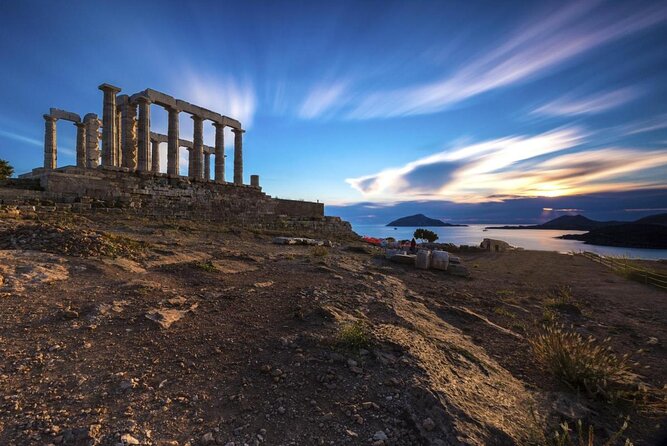
Athens and Cape Sounion offer two very different views of Greece. In the city, you move among monuments tied to ancient Athens, Roman rule, the modern Greek state, and the revival of the Olympic Games. At Sounion, the focus narrows to one dramatic ruin above the sea: the Temple of Poseidon.
That contrast gives this excursion its purpose. A city-only outing would leave out one of Attica’s most memorable ancient sites. A Sounion-only trip would miss several landmarks close to the port. By combining both, you get a broad first look at the region without arranging separate transport.
The tradeoff is pace. You are not getting a long archaeological tour of Athens, nor a leisurely afternoon at the cape. Think of this as a carefully packed introduction, useful when your ship gives you only one day in port.
The private setup matters here. With a guide and driver working only for your group, you can ask questions as you go and avoid the fixed rhythm of a large coach. Still, the exact amount of time at each city stop can depend on traffic, port disembarkation, and your chosen pickup time.
More City Highlights Shore Excursions in Athens
- From Cruise Port: The Acropolis & Athens Highlights Tour
★ 4.6 · 105 reviews - The Highlights of Athens Private Shore Excursion 8 Hours
★ 5.0 · 39 reviews - Embark | Disembark The Highlights Of Athens – 4 H Private Shore Excursion
★ 5.0 · 35 reviews
Starting at Piraeus with a private minivan
Pickup and drop-off at Piraeus Port are included. When you book, you need to provide your ship name, docking time, disembarkation time, and re-boarding time. You also enter your preferred pickup time and reconfirm it 48 hours before departure.
That planning step is not busywork. Cruise days run on a hard clock, and the distance between Piraeus, central Athens, and Cape Sounion makes timing important. Give accurate ship details, and keep your return deadline in mind when agreeing on the pickup time.
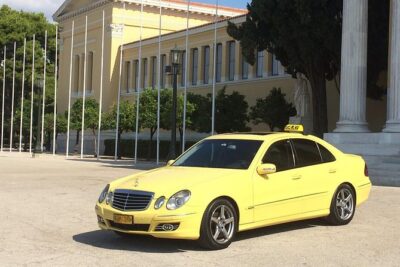
Transport is by private vehicle with a professional driver. The modern, comfortable van is one of the features praised most strongly in the available feedback. That is welcome on a route that includes both city driving and a longer run down the coast.
The guide travels with you and explains the sights, ancient stories, and Greek mythology along the way. Names connected with especially well-regarded bookings include Helen as guide and George as driver. They are not guaranteed for every departure, so ask about the assigned team if that matters to you.
Panathenaic Stadium: a quick look at marble and sport
The Panathenaic Stadium, also called Kallimarmaro, is the first listed stop and comes with about 15 minutes. Its name means beautiful marble, and the point is easy to understand once you see the sweeping white structure.
This is the only stadium in the world built entirely of marble. The original site began as a simple racecourse and was developed for the Panathenaic Games around 330 BC. It was later rebuilt in marble by Herodes Atticus in the second century AD, with seating for about 50,000 people.
The stadium was later abandoned after Christianity became dominant in the fourth century. Excavation began in 1869, and the site hosted the Zappas Olympics in 1870 and 1875. It also played a role in the modern Olympic revival.
Fifteen minutes is enough for photographs and a quick explanation, but not a full visit. Admission is listed as free for this stop. If you enjoy sports history or ancient Greek competitions, you may wish you had longer. For a shore excursion, though, this brief stop gives you a memorable image without consuming the morning.
The city’s grand avenue and the Academy of Athens
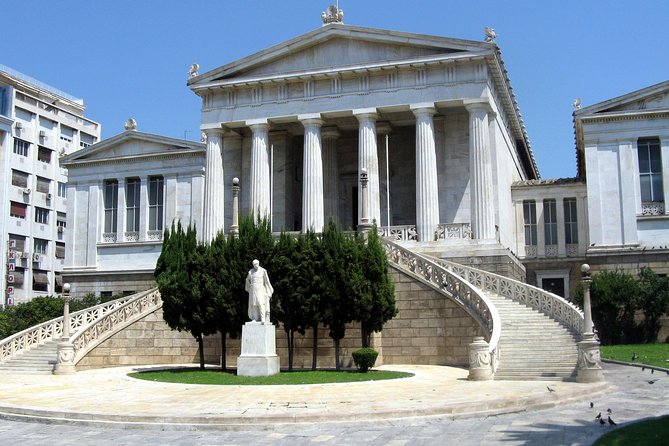
The route also includes the Academy of Athens and the University of Athens. These buildings help show a side of the capital that ancient ruins alone cannot provide: modern Greece’s intellectual and national identity.
The Academy of Athens is the country’s national academy and its highest research institution. It was founded in 1926 and operates under the Ministry of Education. Its main building is one of Athens’s major landmarks, so your guide can explain its place in the city even if the stop is primarily a look from outside.
The University of Athens dates to May 3, 1837, when King Otto founded it as the Othonian University. It was the first university in the newly liberated Greek state and in the wider area of Southeast Europe. Its first faculties were theology, law, medicine, and arts, including applied science and mathematics.
These stops are best understood as part of a moving city tour rather than guaranteed indoor visits. The information provided does not promise entry or a set amount of time at either institution. If you want extended time inside museums or public buildings, this is not the right format. If you want a guide to connect the modern city with its ancient past, the stops add useful context.
More City Highlights Shore Excursions in Greece
- Shore Excursion: Acropolis, Athens City tour and The New Acropolis Museum
★ 4.5 · 30 reviews - Piraeus Shore Excursion: ALL INCLUSIVE Skip-the-Lines Athens sightseeing Tour
★ 4.5 · 27 reviews - Athens City Tour with Acropolis & Plaka from Piraeus Cruise Port
★ 4.5 · 26 reviews - Athens Highlights Shore Excursion Full Day Private Tour
★ 5.0 · 26 reviews
The Temple of Olympian Zeus and Hadrian’s Arch
The Temple of Olympian Zeus is one of the city’s most striking ancient remains. Only a portion of its enormous columns survives, but those columns make the scale clear. The temple was dedicated to Zeus in his Olympian form, the chief god of the Greek pantheon.
Construction began in the sixth century BC under the Athenian tyrants, who imagined the greatest temple in the ancient world. The project took roughly 638 years to finish, finally reaching completion under the Roman emperor Hadrian in the second century AD.
At its height, the temple had 104 colossal columns. It was considered the largest temple in Greece and held a major cult statue. Today, the remaining columns are the main attraction, but the long construction story is just as revealing. Athens was not built in one clean age. Greek and Roman power both left their mark.
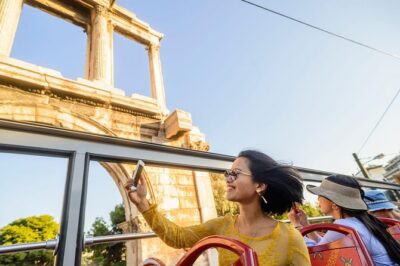
Nearby, Hadrian’s Arch marked the transition between the old city center and the Roman complex around the Temple of Olympian Zeus. The gateway resembles a Roman triumphal arch and was probably built around AD 131 or 132 to honor Hadrian and celebrate the dedication of the temple complex.
These two landmarks work well together. The temple shows ambition on a massive scale; the arch shows how Roman Athens presented itself as both heir to Greek culture and part of the Roman world. Your guide’s explanation is especially valuable here because the surviving stones can otherwise feel disconnected from the city around them.
Syntagma Square and the Tomb of the Unknown Soldier
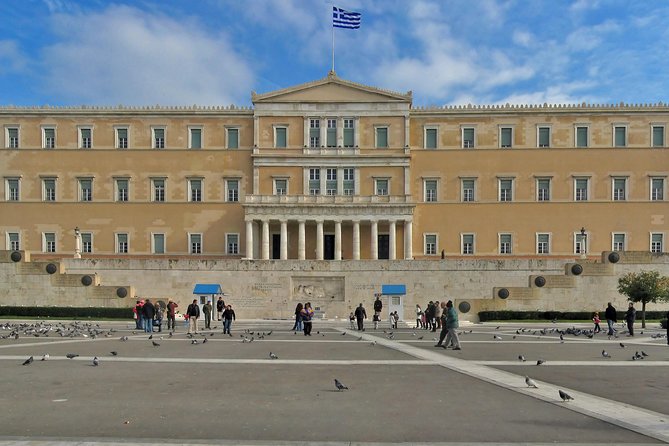
Syntagma Square brings you into the political heart of modern Athens. In front of the Old Royal Palace, now associated with the Greek state, lies the Tomb of the Unknown Soldier.
The monument is a cenotaph for Greek soldiers killed in war. It was sculpted between 1930 and 1932 by Fokion Rok. The tomb is guarded by the Evzones of the Presidential Guard, whose traditional uniforms and formal movements are closely tied to Greek national identity.
The tour includes the tomb, but no specific ceremony time is promised. You should not book this excursion solely to see a changing-of-the-guard event. Instead, treat the stop as a chance to connect ancient Athens with the country’s modern political story.
Syntagma is also a useful place to get your bearings. It shows that Athens is not only an archaeological site. It is a working capital, with government buildings, public squares, and daily city life around the monuments.
From Glyfada to Cape Sounion
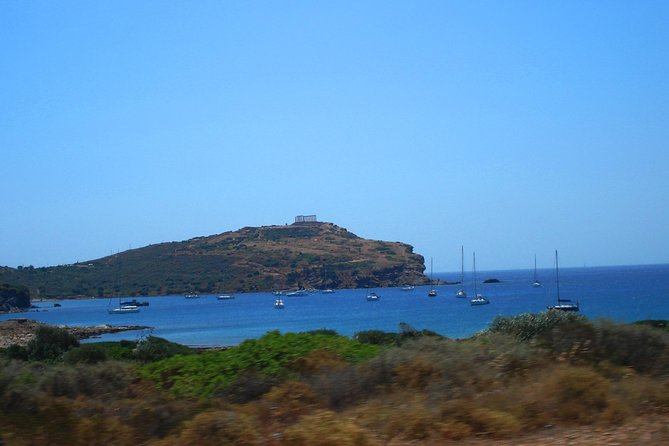
After the central Athens sights, the tour heads toward Cape Sounion. The route passes through Glyfada and follows scenic coastal roads, giving you a change of pace after the dense city center.
The drive is part of the experience, not simply a transfer. You leave behind the formal squares and ancient monuments and follow the edge of Attica toward the cape. Since the tour uses a private vehicle, your guide can continue explaining the area rather than leaving you to manage a separate taxi or bus connection.
The supplied details do not give an exact driving time from Athens to Sounion. Traffic and the day’s starting time can affect the schedule, so keep your expectations flexible. The more time spent in city traffic, the less time may remain for unscheduled stops.
This is where the tour’s private nature can help, but it cannot defeat the clock. You have flexibility within the planned route, not unlimited time. The safest approach is to enjoy the scenery and let the guide keep the day moving.
One and a half hours at the Temple of Poseidon
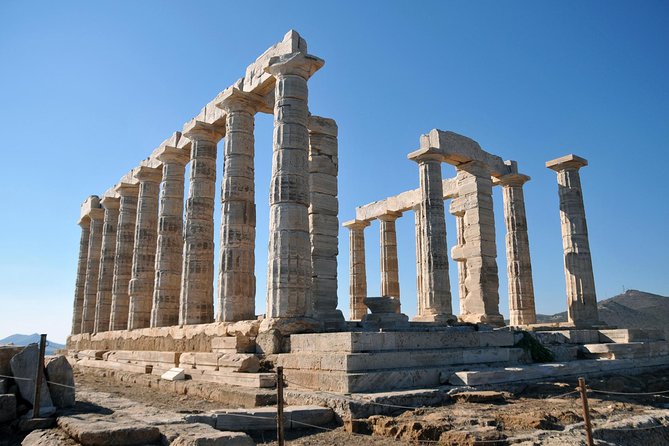
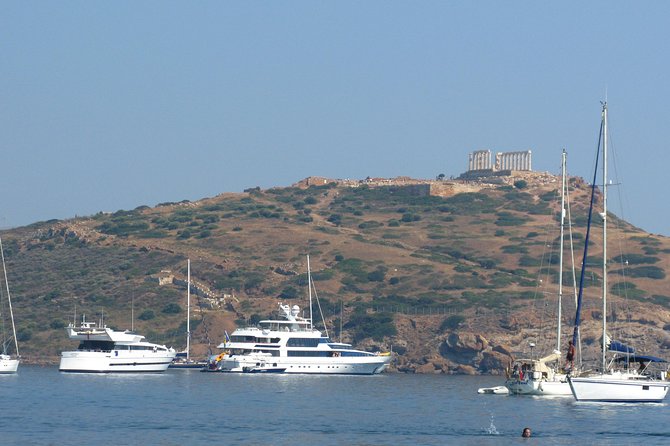
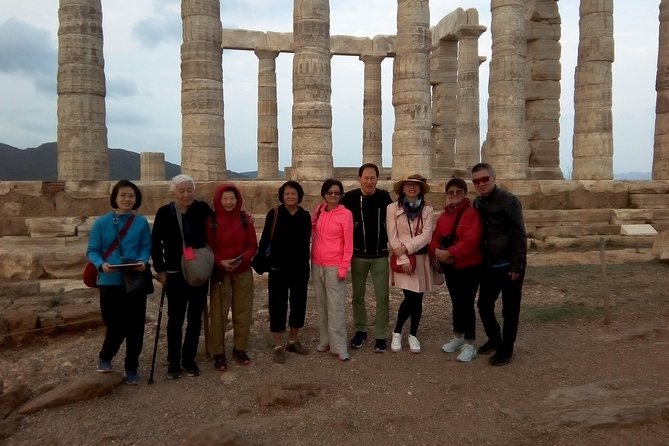
Cape Sounion is the main attraction, with about 90 minutes planned at the Temple of Poseidon. The ruins sit at the tip of the cape, where the temple’s setting is as important as its columns.
An earlier Archaic temple on the site was probably destroyed in 480 BC during the Persian invasion led by Xerxes I. After the Greek victory at Salamis, the Athenians dedicated a captured enemy trireme at Sounion as a trophy to Poseidon. The later temple is the monument you see today in ruined form.
Poseidon was the god of the sea, so this location made practical religious sense for an ancient maritime power. The cape also gave the sanctuary a strong visual presence for ships approaching Attica.
Ninety minutes should give you time to explore the ruins with your guide, hear the main stories, and take photographs. The entry fee is not included, so budget separately for admission. The information provided does not state the exact ticket price.
The temple opening hours listed for this experience are 8:00 AM to 4:00 PM, daily, for the period from March 1, 2025 through February 28, 2026. That makes your pickup time especially important. A late start could put pressure on the Sounion portion, particularly if traffic is slow.
You should also expect some walking and uneven ground at an archaeological site. A moderate level of physical fitness is recommended. Comfortable shoes are a sensible choice, though the tour does not list a special equipment requirement.
Is $480.85 per person a fair price?
At $480.85 per person, this is not a budget shore outing. The price makes the most sense for a small group that values private transport, a dedicated guide, and the convenience of returning directly to the ship.
The cost includes port pickup and drop-off, a professional guide, transport by private vehicle, a professional driver, and the worry-free shore excursion guarantee. Food, drinks, and admission to the Temple of Poseidon are extra.
For one or two people, the price may feel steep compared with a shared coach tour. For a larger private group, the per-person cost can be easier to justify, especially if splitting the vehicle cost among several people. Group discounts are available, though the exact savings are not provided.
The real value is time management. You do not have to find your way from Piraeus into Athens, arrange a second vehicle to Sounion, or worry about combining separate tickets and transfers. If missing the ship is your main concern, the return guarantee adds practical value.
If your priority is entering several Athens museums or spending hours at the Acropolis, this excursion may not be the best use of your money. Its strength is coverage: many major sights in Athens, followed by one substantial excursion beyond the city.
Who will like this six-and-a-half-hour outing?
I would choose this for a first visit to Athens from a cruise ship, especially if you want both major city landmarks and the Temple of Poseidon. It suits families and mixed-age groups who prefer a private minivan to a large coach.
It also works well for people who want a guide to explain what they are seeing. The itinerary includes monuments from several periods, and the connections between them are not always obvious without context.
You should think twice if you dislike a tight schedule, want long museum visits, or prefer to explore one neighborhood on foot. The tour is active and road-based. It gives you range, but not much unplanned wandering.
Children who do not occupy a seat are free. Children who use a seat and are up to 11 years old receive a discount. The tour is private, so only your group participates.
Should you book it?
Book this tour if you want a broad Athens introduction plus Cape Sounion and you value a private vehicle, port pickup, and a clear return plan. The combination of the Panathenaic Stadium, Syntagma Square, Roman-era monuments, and Poseidon’s coastal temple is hard to arrange as neatly on your own during a cruise stop.
Skip it if you want a slow archaeological day or need a lower-cost option. At this price, you are paying for convenience, private service, and coverage rather than long visits at each site. Confirm the pickup time, ask whether Helen and George are assigned to your departure, and allow extra money for Poseidon Temple admission before booking.
FAQ
How long does the Athens and Cape Sounion excursion last?
The tour lasts approximately 6 hours and 30 minutes.
Where does pickup take place?
Pickup and drop-off are offered at Piraeus Port. Cruise passengers must provide their ship and docking details when booking.
Is the tour private?
Yes. Only your group participates in the activity, with transport by private vehicle.
What sights are included in the Athens portion?
The route includes the Panathenaic Stadium, Temple of Olympian Zeus, Academy of Athens, University of Athens, Hadrian’s Arch, Syntagma Square, and the Tomb of the Unknown Soldier.
How long do you spend at the Panathenaic Stadium?
The planned time at the Panathenaic Stadium is about 15 minutes. Admission is listed as free.
How long is the visit to the Temple of Poseidon?
The planned visit to the Temple of Poseidon lasts about 1 hour and 30 minutes.
Is admission to the Temple of Poseidon included?
No. The entrance fee for the Temple of Poseidon is not included in the tour price.
Are food and drinks included?
No. Food and drinks are not included.
What happens if my cruise ship is delayed?
The tour includes a worry-free shore excursion guarantee with guaranteed on-time return to your ship. You still need to provide accurate ship timing details and reconfirm your preferred pickup time 48 hours before departure.
More Private Shore Excursions in Greece
- Private Departure Transfer: Central Athens to Piraeus Cruise Port
★ 4.5 · 89 reviews - Athens Shore Excursion: Private City Sightseeing and Acropolis Tour
★ 4.5 · 22 reviews - Half Day Private Athens Shore Excursion
★ 5.0 · 20 reviews - Athens Private Group Shore Excursion
★ 4.5 · 18 reviews
More Private Shore Excursions in Athens
- Athens Private Transfer: Piraeus Cruise Port to Central Athens
★ 4.0 · 249 reviews - Essential Athens Full Day Private Tour – Best Shore Excursion
★ 5.0 · 168 reviews - Athens Private Transfer: Central Athens to Piraeus Cruise Port
★ 4.5 · 163 reviews - Private Arrival Transfer: Piraeus Cruise Port to Central Athens
★ 4.5 · 90 reviews
Just added around Athens
- Private Shore Excursion: Sightseeing of Athens and the Acropolis★ 5.0 · 3 reviews
- “Athens in a Glimpse with Cruise Port Pickup & Drop-Off”★ 5.0 · 16 reviews
- The Golden Age of Athens 6H private shore excursion -With Tickets★ 5.0 · 2 reviews
- Private Transfers From / To Piraeus Cruise Terminal★ 4.0 · 4 reviews
- Shore Excursion: Argolida -Mycenae, Nafplio and Epidaurus Private Day Trip★ 4.5 · 2 reviews
- Athens Private Departure Transfer to Piraeus Cruise Port★ 4.0 · 6 reviews
- Private Transfer from Piraeus (Athens) Cruise Port to Athens★ 5.0 · 4 reviews
- Private Shore Excursion Driving Tour of Athens Best and Athenian Riviera★ 5.0 · 2 reviews
Athens Shore Excursions, compared.
Athens Private Transfer: Central Athens to Piraeus Cruise Port
Read our review →
From Cruise Port: The Acropolis & Athens Highlights Tour
Read our review →
Private Departure Transfer: Central Athens to Piraeus Cruise Port
Read our review →
Athens for CRUISE SHIPS with opt. Acropolis from Piraeus Port
Read our review →